Baby Footprints Machine Embroidery
First Impression: Soft, Sweet, and Instantly Recognizable
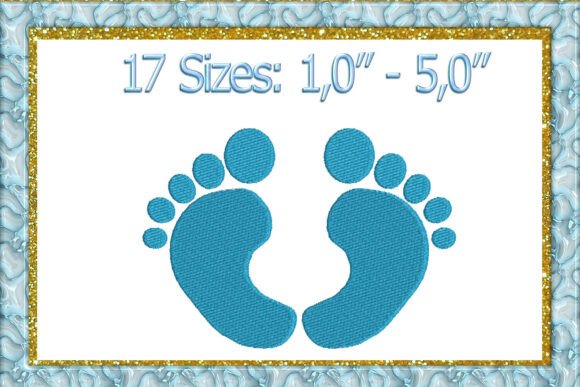
As an embroidery designer who’s prepped over 200 craft fair booths—and watched thousands of shoppers pause at a single stitch—I’ll say this upfront: Baby Footprints Machine Embroidery lands with quiet charm. It’s not bold or flashy. It’s not rustic or modern—it’s tender, minimal, and emotionally resonant. That tiny footprint shape (just 1.02” x 0.69” at its smallest) reads instantly as “baby,” “new life,” “first moments.” No words needed. No extra embellishment required. That simplicity is its biggest strength—especially when you’re selling handmade products to gift-givers, new parents, grandparents, and keepsake collectors.
Where It Shines: Craft Fair Product Placement That Converts
This design doesn’t need center stage—it thrives as a thoughtful accent. On a natural linen tote bag? Perfect near the bottom corner, just above the seam—soft but intentional. On a cotton apron? Ideal on the left chest, small enough to avoid overwhelming the fabric but large enough to catch the eye of a mom browsing kitchen wares. For tea towel embroidery, it works beautifully in the lower right corner, paired with a simple monogram or left solo for clean, heartfelt impact.
It’s also a standout on embroidered patches—especially when backed with iron-on adhesive for easy gifting. Small fabric pouches (think baby shower favors or diaper bag organizers) gain instant warmth with one centered footprint. Pillow covers? Yes—but keep it small and subtle, not oversized. And for caps? Use only the larger sizes (3”+), and test thoroughly on curved surfaces—tiny footprints vanish on domed crowns.
What Buyers Actually Notice—And Why They Reach Out
In person, customers don’t read file specs—they feel meaning. At a busy craft fair, Baby Footprints Machine Embroidery triggers emotional recognition faster than any slogan. A grandmother stops mid-aisle. A dad points it out to his partner. A friend buying a baby shower gift pauses, touches the stitching, and asks, “Is that real baby size?” That tactile moment—where hand-stitched quality meets personal significance—is where sales happen.
It elevates perceived value without raising price. A $24 tea towel becomes a $32 keepsake. A $16 pouch becomes a $22 heirloom-style favor. That’s the power of a well-placed, emotionally intelligent machine embroidery design.
Production Reality Check: What Works—and What Needs Caution
This is a highly repeatable design for batch production—17 sizes means flexibility across product types. But don’t assume all sizes behave the same. The smallest (1.02”) is delicate. On textured towels or thick denim, details blur. On dark fabric, low-contrast thread colors disappear entirely. Tiny areas—especially the curve of the heel and toe indentations—can collapse if stitch density is too high or stabilizer is too light.
Here’s what I always test before booth prep:
- Stabilizer match: Tear-away for smooth cottons; cut-away for knits or stretchy fabrics; no-show mesh for lightweight linens.
- Thread contrast: Always use high-visibility thread (e.g., ecru on navy, white on charcoal)—not matching thread—unless you want it to fade into the background.
- Hoop size & spacing: Confirm your hoop accommodates the largest size you plan to use. Also check spacing between multiple footprints—crowding kills clarity.
- Fabric texture test: Run a sample on your exact tea towel or cap fabric—not just scrap muslin. Texture eats fine detail.
Online Appeal: From Etsy Listing to Printable Mockup
This design photographs exceptionally well—clean lines, balanced negative space, and strong silhouette make it ideal for digital listings. It scales beautifully in printable mockups: place it on a neutral background with soft shadowing, and it reads as premium, handmade, and intentional. For Etsy sellers, pair it with keywords like “baby shower gift,” “newborn keepsake,” “personalized baby towel,” and “small batch embroidery”—but avoid overloading. Let the image do the work.
It also supports brand consistency. If your shop leans gentle, earthy, or minimalist, Baby Footprints Machine Embroidery reinforces that voice across product categories—no rebranding needed.
Smart Selling Notes for Handmade Business Owners
Don’t treat this as a standalone design—treat it as a design asset with layered utility:
- Use the medium sizes (2.5”–4”) for booth samples—large enough to be legible from 3 feet away, small enough to fit multiple products on one table.
- Bundle it with coordinating designs (e.g., a tiny heart, initial, or “Welcome Little One” script) for higher average order value.
- Offer it pre-embroidered on bestsellers—like organic cotton onesies or muslin swaddle sets—to reduce customer decision fatigue.
- For digital sellers: clearly state commercial licensing terms *before* purchase. Buyers need to know if they can sell finished products—don’t leave that ambiguous.
Final Designer Verdict: A Quiet Workhorse with Heart
Baby Footprints Machine Embroidery isn’t the loudest design in your library—but it’s among the most reliable. It sells consistently across seasons, appeals broadly (yes, even for Boys-focused collections), and pairs effortlessly with other sentimental themes. It doesn’t shout. It whispers—and in a crowded craft fair, sometimes the whisper is the one people lean in to hear.
Before your next market weekend: stitch one on scrap fabric, hold it up beside your actual products, and ask yourself—does it feel like something someone would buy *and keep*? If yes—you’ve got a keeper. Now go make something meaningful.